A brand with six segments that sends 3 to 4 campaigns a week needs 18 to 24 different emails every week. Nobody has that bandwidth. That math is why Klaviyo segmentation goes wrong so often: brands build too many segments, then can't feed them.
What actually moves campaign revenue
Segmentation matters. It just isn't the first lever. When we look at campaign revenue, this is the order of priority:
- Send volume. 3 to 4 campaigns a week beats one a week every time.
- Topics. A strong idea sent broadly beats a weak idea sent to the perfect segment.
- Content. The writing and the design.
So our rule is simple. Segment deeply in flows, because you set them up once and they run forever. Keep campaigns broad and send them to engaged segments at high volume.
Quick refresher on the terms. A list in Klaviyo is static: people join by signing up and leave by unsubscribing. A segment updates itself in real time based on behavior. Almost everything below is a segment.
The engaged segments (build these first)
These are the foundation of all Klaviyo segmentation, and the main protection for your deliverability. We send 80 to 90% of campaigns to engaged segments and aim for open rates of 45% or more.
| Segment | Who is in it | How often they get campaigns |
|---|---|---|
| Engaged 30 days | Opened or clicked in the last 30 days | 4x a week |
| Engaged 60 days | Opened or clicked in the last 60 days | 3x a week |
| Engaged 90 days | Opened or clicked in the last 90 days | 2x a week. Most campaigns go here |
| Unengaged 120+ days | No engagement for 120 days or more | Excluded or suppressed |
One improvement worth making: count site activity too. An enriched engaged segment includes everyone who opened or clicked an email or was active on your site in that window. That is more accurate than email activity alone, because plenty of people come back to shop without clicking anything.
Purchase segments
These decide who should and shouldn't get a promotion.
- Recent purchasers (bought in the last 14 to 30 days). Exclude them from promotional campaigns. Nobody likes a discount email right after paying full price.
- Repeat customers (2 or more orders). The best audience for upsells and cross-sells.
- One-time buyers. Your win-back targets.
- Lapsed customers (no order in 90+ days). They get re-engagement offers.
For sales we use one more combination: 90-day engaged, excluding everyone who already bought during the sale. That keeps the reminder emails away from people who already ordered. The full sequence is in our sale email guide.
Value and product segments
Once the basics run, these add precision without much extra work:
- VIPs, the top 10% of spenders. Early access, first look at launches.
- High predicted lifetime value. Klaviyo calculates this for you once you have enough order history.
- Bought A, not B. The simplest cross-sell segment there is, and a natural fit for a flow.
- Category interest, based on what people browse or buy.
Keep this layer small. Two or three of these are plenty for most brands, and each one should feed a specific flow or a campaign you already plan to send. If you can't name the email a segment is for, you probably don't need it yet.
Location gets its own mention. You rarely need a segment per city, but you do need to know which profiles fall under GDPR or CCPA, and country segments matter as soon as you sell in more than one market or language.
Klaviyo segmentation mistakes we see in audits
- Over-segmenting. Tiny segments that never move the needle.
- Under-segmenting. Every campaign to the whole list, including people who haven't opened in a year.
- Wrong AND/OR logic. One misplaced condition and the segment holds the opposite of what you wanted. Check the profile count after every change.
- No deliverability segments. Without engaged tiers, your unengaged profiles drag down inbox placement for everyone else.
- Not excluding recent buyers. Your best customers get emails that don't apply to them.
- Segments built just to have them. If no campaign or flow uses a segment, delete it.
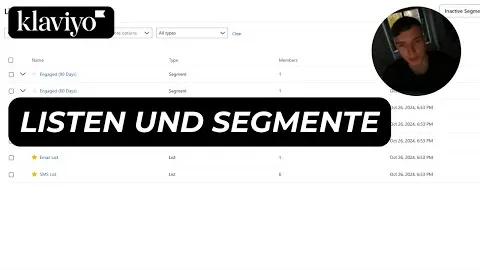
Leon also made a segmentation video for YouTube: Leon's video (German).
Watch Leon walk through it
Free on YouTube, in German.
Questions we get a lot
What is the difference between a list and a segment in Klaviyo?
A list is static. People join it by signing up and leave by unsubscribing. A segment is dynamic: profiles move in and out automatically, in real time, based on what they do.
Which segment should I send most campaigns to?
Your 90-day engaged segment. We send 80 to 90% of campaigns to engaged segments, with the 90-day one as the baseline.
How many segments do I need?
Fewer than you think. A handful of engagement and purchase segments covers most campaigns. Deep segmentation belongs in your flows, where you set it up once and it runs on its own.
Should I exclude recent buyers from campaigns?
From promotional campaigns, yes. People who bought in the last 14 to 30 days should not get a discount email right after paying full price.