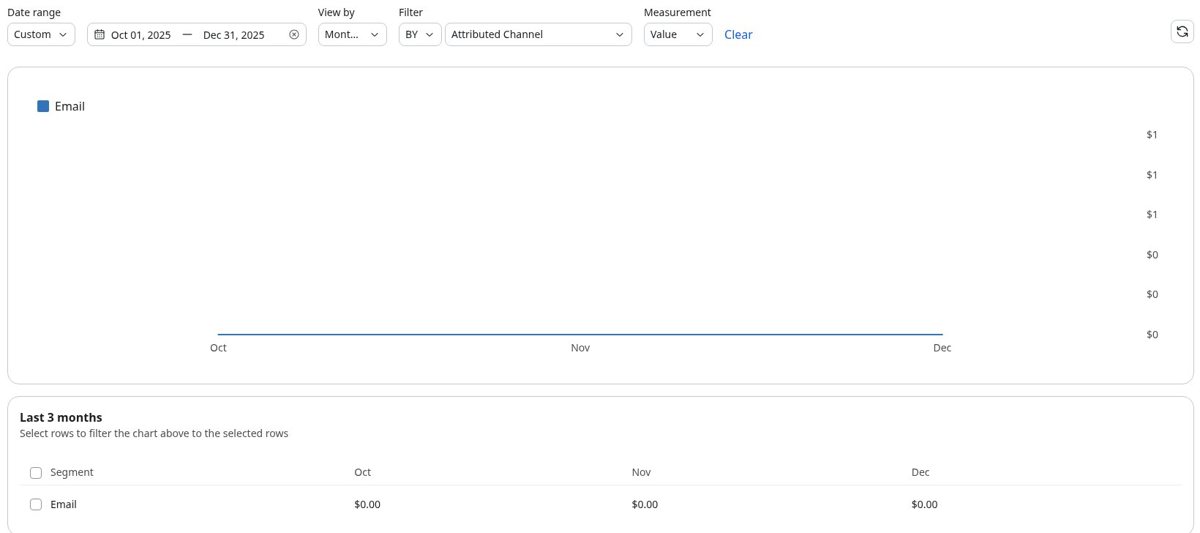
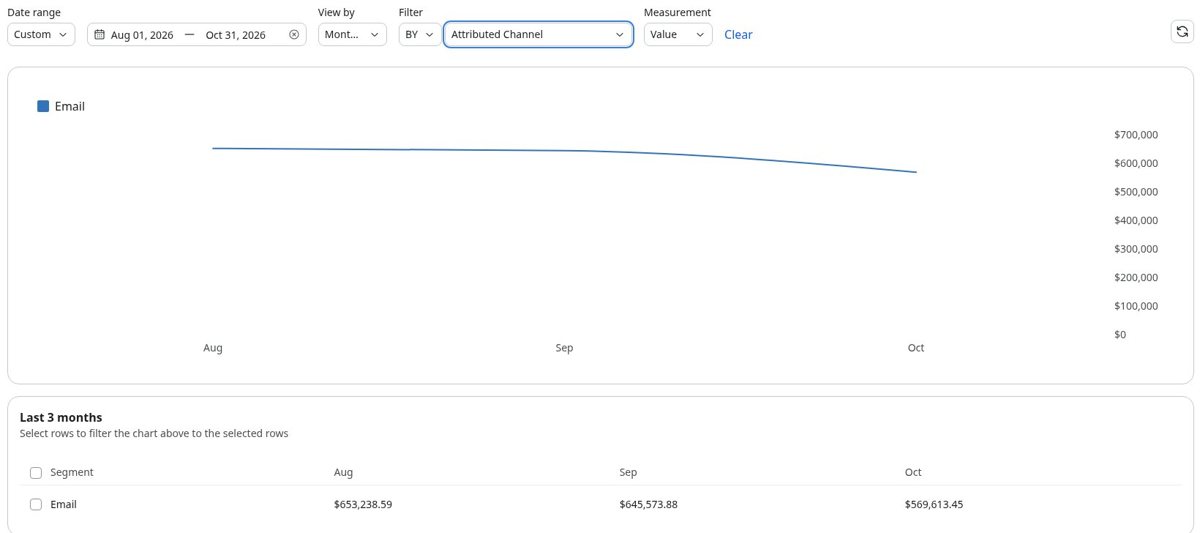
In October, November and December 2025 this store did about $166k a month in revenue. Klaviyo attributed exactly $0 of it to email. Ten months after our first flow went live, email was bringing in $622.8k a month.
- Email revenue: $0 a month before, $622.8k a month now (average of August to October 2026)
- Share of store revenue from email: 0.0% before, 31.9% now, peak 40.3% in March 2026
- $3.16M from email in the first 10 months
- 1 to 22 November: $0 in 2025, $503.9k in 2026 (partial, Black Friday is still running)
The brand sells pickleball court shoes and a small range of accessories in the US. Its buyers play a lot, often several times a week, and many are older players who care about comfort and keeping their joints happy. They read. They compare. And they want proof before they spend money on shoes.
The starting point
When we started in January 2026, the store was already selling. It averaged about $166k a month from October to December 2025, almost all of it from paid traffic. Klaviyo was installed, but email made no money. The account showed $0 in attributed email revenue for each of those three months.
So there was nothing to fix. There was just nothing there. New sign-ups got no welcome series, and nobody heard from the brand after an abandoned checkout or after a first order. A visitor who came in through an ad and didn't buy right away was gone for good. And every repeat order had to be bought again through ads, at full acquisition cost.
What we built
Flows first
Flows went live on 7 January 2026, and the first batch was the one closest to the money: a welcome series for new sign-ups, checkout abandonment, browse abandonment and site abandonment, plus a post-purchase series and a winback for buyers who hadn't come back. SMS flows followed in August 2026. By November 2026 the account had 24 live flows.
For this audience the post-purchase emails matter more than usual. Shoes raise questions after delivery about fit, break-in and sizing. Answering those in the inbox heads off returns and builds the trust that leads to a second pair or an accessory.
Campaigns at about 3 to 4 sends a week
The first campaign went out on 10 January 2026. From there we planned month by month, usually about 3 to 4 sends a week, with a few SMS each month on top of email. By November the brand had sent 143 campaigns.
Most of them taught something. The buyers wanted to understand why a shoe feels the way it does, so a lot of emails explained fit and comfort in plain language and backed it with reviews from other players. Sales and launches came on top of that, with VIP early access ahead of Black Friday.
Two formats, one voice
We mixed designed emails with plain text notes signed by the founder. Designed emails carried launches, product education and sales. The plain text emails read like a short message from a person who plays the sport, and for an older, skeptical audience that format often did as well as the designed ones. Everything was written in US English for a US list.
Segments
Campaigns went to engaged segments first, with bigger sends for sales and launches. Buyers and non-buyers saw different angles, and SMS went to subscribers who had opted in.
Results
| Metric | Before (Oct to Dec 2025) | Now (Aug to Oct 2026) |
|---|---|---|
| Email revenue per month | $0 | $622.8k |
| Share of store revenue | 0.0% | 31.9% |
| Of which flows | $0 | $393k |
| Of which campaigns | $0 | $229k |
From January to October 2026 email brought in $3.16M. Since the baseline was zero, the whole $3.16M counts as lift over the starting point.
The best month was August 2026 at $653k from email. The highest share came earlier, in March 2026, when email was 40.3% of all revenue. That was three months after the first flow went live.
Flows carry the larger part: $393k of the $623k a month. Campaigns add $229k. That split is healthy. Flows earn on every new visitor and buyer without anyone pressing send, and campaigns add the peaks.
Black Friday so far
| Period | Email revenue |
|---|---|
| 1 to 22 November 2025 | $0 |
| 1 to 22 November 2026 (partial) | $503.9k (37.4% share) |
November 2026 is still running, so these are partial numbers pulled on 23 November.
Proof from Klaviyo
These are screenshots from the brand's own Klaviyo account: Placed Order value by month, filtered by attributed channel. We removed everything that could identify the brand. The monthly averages on this page come straight from these screenshots. Totals since the start, record months outside these windows and the November figures come from the same account and also count SMS where the brand uses it.
What drove it
Flows that catch the traffic the ads already pay for
The store had plenty of visitors. Most of them left without buying, and nobody followed up. The welcome series and the abandonment flows turned that existing traffic into orders, and that's why the flows alone now account for $393k a month.
Education over discounts
These buyers don't buy shoes on impulse. Emails that explained fit and comfort, backed by other players' reviews, gave them reasons to buy at full price. Discounts stayed for real moments like Black Friday.
A steady sending rhythm
About 3 to 4 sends a week, every week, kept the brand in the inbox without wearing people out. The list learned to expect something useful, and that made the sale emails land harder when they came.
Plain text from the founder
For an older audience a short note from the founder feels personal in a way a banner doesn't. We kept those emails in the mix every month.
The honest part
The store grew about 12x over the same ten months, mostly through ads. A big part of the extra email revenue comes from more people landing on the site, so we don't claim that every dollar was caused by email. That's why we lead with two things. Email went from zero to a real channel, and it now holds 31.9% of a much bigger store. Holding that share while traffic grows that fast takes a working system, but it is not proof that email caused the growth.
The numbers are Klaviyo Placed Order revenue that Klaviyo attributes to email or SMS. Attribution windows always give email some credit for orders that might have happened anyway. And the Black Friday figures are partial.
What other brands can take from this
- Zero is a starting point. If Klaviyo shows $0 from email, the quickest money is in welcome, cart and checkout flows. They work on traffic you already pay for.
- Give checkout its own flow. Someone who reached checkout is much closer to buying than someone who only looked at a product page. Those two people should get different emails, with different timing.
- Teach first if your product needs it. Shoes, wellness and anything with a fit question sell better with explanation than with a coupon.
- Keep plain text in the mix. A short note from a real person often beats a polished design, especially with older buyers.
- Watch the share, not only the revenue. If your store is growing fast, share of revenue tells you if email keeps up. Revenue alone will always look good while traffic climbs.
Want to know what your account is leaving on the table? Book the free 30 minute Klaviyo audit. More on the flows behind this case: welcome flow, abandoned cart flow and plain text emails.
FAQ
How much revenue did email bring in for this brand?
From January to October 2026 email brought in $3.16M. From August to October 2026 it averaged $622.8k a month, which was 31.9% of store revenue. From 1 to 22 November 2026 it brought in $503.9k, and November 2026 is still running.
Did email cause all of that growth?
No. The store itself grew about 12x over the same period, mostly through traffic. That's why we lead with the move from zero and the share of revenue. A share of 31.9% on a much bigger store means email kept up with the growth and added to it.
How long did it take to see results?
Flows went live on 7 January 2026 and the first campaign went out on 10 January. The share of revenue from email peaked at 40.3% in March 2026, three months in.
What did the brand send?
24 live flows and 143 campaigns by November 2026. Campaigns ran at about 3 to 4 sends a week, mostly email with a few SMS each month, mixing designed emails and plain text notes from the founder.
Can my brand get the same result?
Every account starts from a different place. A brand that sends nothing today usually has the most room. Book the free 30 minute Klaviyo audit and we'll show you where your account stands.